Tuesday, 25 November 2014

HTML


HTML or HyperText Markup Language - standard markup language used to create webpages.

It is written in the form of HTML elements consisting of tags enclosed in angle brackets list <html>.

HTML tags most commonly come in pairs like <h1> and </h1>, the first tag in a pair is the start tag, and the second tag is the end tag, which also are called opening and closing tags.

Some tags represent empty elements and are unpaired for example <img>

A web browser read HTML files without display the HTML tags and interpret them into visible or audible web pages.

HTML allows to create structured documents by denoting structural semantics for text such as headings, paragraphs, lists, links, quotes and other items. Semantics within HTML is the practice of giving content on the page meaning and structure by using proper element.

For last week lectures, we learn how tho create structured documents. Here is the pictures where we create the HTML consisting all of what we have learn by combining table, links, pictures, headings, and other items.


Now, do you want to learn how to make HTML??? You can click here to see more lists of HTML elements.

Some HTML lists that we study:


HTML List

Description

Unordered List

An unordered list starts with the <ul> tag. Each list item starts with the <li> tag.

The list items will be marked with bullets (small black circles), circles, or squares.

Example:

<ul>

<li>Coffee</li>

<li>Tea</li>

<li>Milk</li>

</ul>

Ordered List

An ordered list starts with the <ol> tag. Each list item starts with the <li> tag.

The list items will be marked with numbers, uppercase letters, lowercase letters, uppercase roman numbers, or lowercase roman numbers.

Example:

<ol>

  <li>Coffee</li>

  <li>Milk</li>

</ol>

Description List

A description list, is a list of terms, with a description of each term.

The <dl> tag defines a description list.

The <dt> tag defines the term (name), and the <dd> tag defines the data (description).

Example:

<dl>

  <dt>Coffee</dt>

  <dd>- black hot drink</dd>

  <dt>Milk</dt>

  <dd>- white cold drink</dd>

</dl>


Tuesday, 18 November 2014

Let's Do The Smile

The simplified molecular-input entry system which is known as SMILES is a specification in the form of a line for describing the structure of chemical species using ASCII strings. Usually the smiles strings can be imported by most molecule editors for conversion back into 2-D drawings or 3-D drawings models of the molecule.

There are many functions of SMILES. SMILES notations could allow the specification of configuration at tetrahedral centers and double bond geometry. This kind of features cannot be specified by connectivity alone SMILES which encode this information are termed isometric SMILES. The most a notable feature of this rules is that they only allow rigorous partial specification of chirality.

This is the example of the structure using SMILES notations:


To know more details about SMILES notation, you can click here :))

There are many complex molecules can be drawn using SMILES


Structure
Symbol
Single bond
-
Double bond
=
Triple bond
#
Aromatic
:

Wednesday, 12 November 2014

All About ChemSketch!!


ACD/ChemSketch is a drawing interface that can help you to draw chemical structure such as organics, organometallics, polymers, and Markush structures.

 
This software can help us to draw and view structures in 2D, or render in 3D to view from any angle. it also can be used to draw reactions and reaction schemes, and calculate reactant quantities.

During our class last week, we learn how to draw vacuum distillation apparatus, chain of DNA strands, different kind of orbitals, energy of reaction diagram, lipids and micelles and how to create table.

This link below is the drawing we have done using ChemSketch
ChemSketch

The features of the ChemSketch : 

FEATURES

Generate structures from InChI and SMILES strings

Generate IUPAC systematic names for molecules of up to 50 atoms and 3 ring structures

Predict logP for individual structures

Search for structures in the built-in dictionary of over 165,000 systematic, trivial, and trade names


Tuesday, 4 November 2014

MAPLE


What is Maple? Have you ever crossed the word 'Maple' in your mind? 
Usually, only computer-based and mathematical-based people know about the Maple. Normal people doing the calculus or mathematical calculation by manual. Maple is a commercial computer algebra system that has been developed by Maplesoft, a company based in Waterloo, Ontario, Canada.  

These are the overview of Maple:
  • It has over than 5000 functions.
  • It offers the breadth, depth, and performance to handle every type of mathematics.
  • Maple's intuitive interface supports multiple styles of interaction, from Clickable Math tools to a sophisticated programming language.
  • People can automatically capture all the technical knowledge in an electronic form that combines calculations, explanatory text and math, graphics, images, sound, and diagrams, tools to a sophisticated programming language.
  • Advanced analysis tools for the mathematically rigorous development of the concept
  • Sophisticated development tools for the creations of efficient algorithms and easy-to-use-interface. 
  • A strong connection between the engineering knowledge in the final application. 

What Maple can do?
 
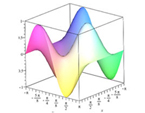
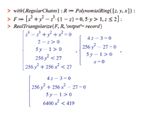
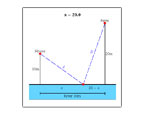
Here are the examples:


Figure 1: Symbolic and Numeric Math


Figure 2: Equation Solving


Figure 3: Differentitial Calculus


The advantages and disadvantages of using Maple:


ADVANTAGES
DISADVANTAGES
·         Very powerful language
·         Name convention are great
·         Many paradigm OOP/list/pattern mathing/logic programming
·         Ability of compile mode of some code
·         Very strong symbolic computation
·         Wolfram alpha is very good tool to dive in to world knowledge
·         Can be used to presentation because GUI is look like Notepad
·         Very good visualization library
·         Cost for extension
·         Long learning curve
·         Slow interpreter
·         It is hard to write the modular code
·         OOP is possible but is very unusable


Click here to download Maple software.